5 Signs Your Company Needs to Integrate Data Now
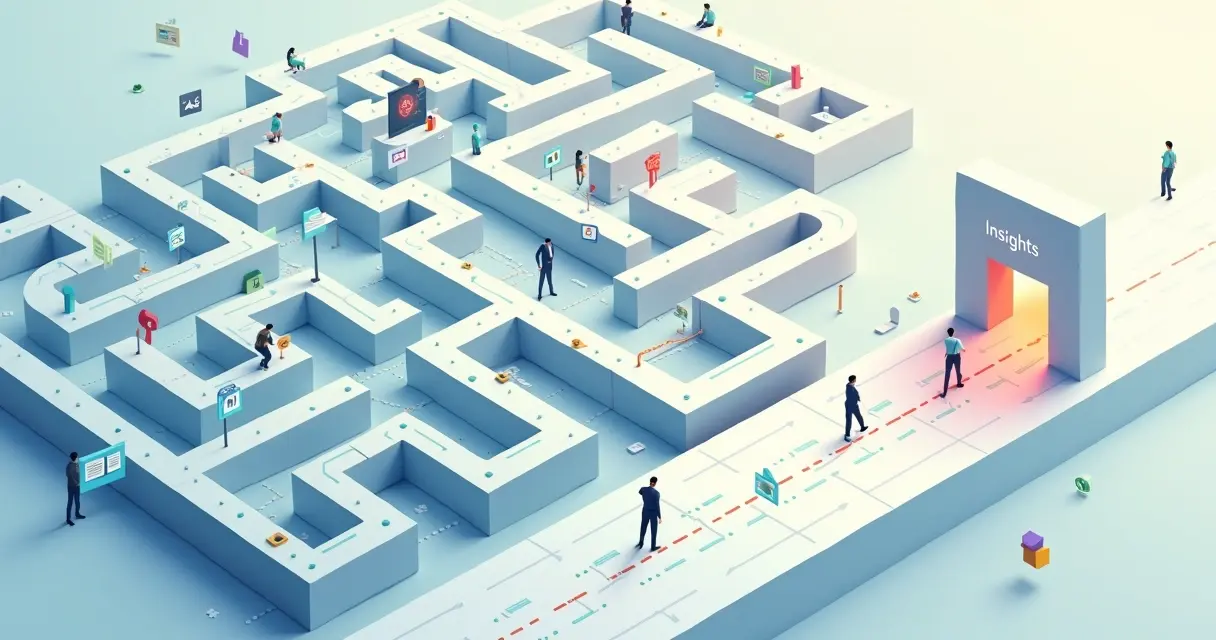
Making smart and quick decisions has never been so necessary. Every day, new technological tools, management systems, and sales, marketing, and customer service channels emerge. This causes information to be scattered in various places, increasing the chance of missing opportunities to improve processes and achieve better results.
According to IBGE data, the percentage of industrial companies that adopted artificial intelligence jumped from 16.9% to 41.9% between 2022 and 2024, showing how quickly the concern with technology and data has evolved. The growth of AI use in Brazilian companies indicates that data integration is no longer an option but a necessity.
But how do you know if your company also needs to make this change immediately? See the five main signs that it's time to invest in data integration and understand how platforms like Sherlok can transform your way of working, simplifying decisions and boosting growth.
Sign 1: Difficulty gathering information in one place
Who hasn't spent hours searching for data in different systems, spreadsheets, and emails before an important meeting? This scenario is still common in small and medium-sized businesses but also affects larger organizations.
When information is scattered across various systems that don't communicate, problems arise such as:
Manual reports, prone to errors
Difficulty in cross-referencing information between departments
Delays in decisions due to time spent collecting and verifying data
Teams working with different views of reality
According to an IBGE survey, 84.9% of medium and large industries in Brazil already use at least one advanced digital solution. Companies of all sizes need to adapt and integrate systems to keep up.
Wasting time gathering data is a sign that information is not flowing as it should in your company.
Sign 2: Lack of confidence in presented numbers
Another clear sign that integration is urgent arises when there is no confidence in the reports or analyses shown in meetings. Different sectors may present diverging numbers on similar results. Often, this occurs because each area generates reports from its own system, without standardization or integration.
Without integrated data, decisions are based on inconsistent numbers, increasing risks and hindering planning.
Sign 3: Slowness or difficulties in making decisions
Companies that do not have a platform like Sherlok often face slowness in decision-making processes, as each new strategy requires a journey of searching, preparing, and analyzing data from diverse sources. In increasingly fast markets, this becomes a problem not only internally but also competitively.
Lack of clear overall vision impairs goal setting;
Real-time monitoring becomes impossible;
Opportunities to act at the right time are missed.
Sherlok, for example, solves this bottleneck by allowing automatic insight extraction, supporting strategies with agility and precision.
Sign 4: Growing data volume without a structure for intelligent analysis
As the company grows, data accumulation is inevitable: customers, sales, marketing performance, inventory, customer service, social media. However, without proper integration, this increase becomes a difficult challenge to control and analyze.
Data alone generates no value if it is not organized and ready for analysis.
Tools that unite all this data in one place, with structure and intelligence, give the company real advantages, allowing automations, predictive analyses with AI, and, in the future, even automatic triggering of strategies, features present in Sherlok.
Sign 5: Lack of automation and alerts about opportunities or risks
Companies with isolated systems rarely manage to quickly identify opportunities and risks. Automatic notifications, AI predictive analyses, and facilities like task automation only become possible after an initial step: uniting everything into a connected data ecosystem.
Imagine being automatically notified when sales fall below average or when a product deviates from consumption patterns. Results tend to improve rapidly, as the problem is addressed in record time.
Tools like Sherlok already allow you to configure intelligent alerts without programming, providing action recommendations and drastically reducing response time.
What are the next steps?
After identifying any of these signs, management should not delay changes. Integrating information is a step that provides clarity, speed, and control. Platforms like Sherlok were created for those who experience these challenges and wish to give more autonomy to their teams, without increasing the technical complexity of daily operations.
To understand more about concepts and practical approaches, it is recommended to consult guides such as the Simple guide to integrating and analyzing data and follow updates on data integration and automations.
How to turn integration into results?
Having truly connected data changes the way you compete in the market. The advantages are clear: consistent reports, a single customer view, and smarter processes. Roadmaps guiding how to create agile data pipelines or use real-time automatic integrations show that technology is accessible and ready for businesses of all sizes.
And most interestingly: integration with AI opens doors to advanced analyses, forecasts, and automation, making companies more modern, secure, and prepared to grow.
Winning companies act based on true and agile information. This starts with data integration.
Conclusion
Paying attention to the signs that it's time to integrate information is a first step to growing sustainably, transparently, and with less rework. Sherlok was developed to eliminate obstacles and allow companies, regardless of size, to achieve impressive results simply, quickly, and without requiring advanced technical knowledge.
If any of the mentioned signs are part of your company's reality, this is the best time to learn about Sherlok and transform your relationship with data, artificial intelligence, and integration. Start valuing information more and see what the future holds for your company!
Frequently asked questions about integrated data and AI in companies
What is integrated data in a company?
Integrated data refers to information from various areas and systems of an organization gathered in a single, standardized, and accessible environment. This process allows all areas to share a common source of reliable information, facilitating more secure analyses and decisions.
How can integrating data help my company?
Integrating information from systems, spreadsheets, and digital tools eliminates rework, reduces errors, and allows for the creation of automatic reports, in addition to enabling advanced analyses. With connected data, teams gain a unified view of all bottlenecks, opportunities, and business results.
What are the benefits of integrating data and AI?
The combination of integrated information and artificial intelligence brings benefits such as automation of routine processes, generation of automatic insights, preventive alerts, and quick action recommendations. This helps the company anticipate trends and act more strategically in the market.
How do I know if I need to integrate my data?
If the company has difficulty gathering information from different sources, shows inconsistencies in reports, or identifies that decisions are delayed due to lack of clarity, it's time to rethink the current method. These are clear signs that integration will bring practical gains.
Does data integration increase company productivity?
Yes. With centralized information, teams spend less time searching for and verifying data, act proactively, and focus more on solving problems than on operational bureaucracy. This results in quick responses, reduced errors, and greater assertiveness in the company's daily operations.
Your AI agents already know what to do in your account.
Turn them on free, no credit card.
- No credit card
- Read-only access
- Revoke it any time