
Practical Guide: Data Analysis with Artificial Intelligence
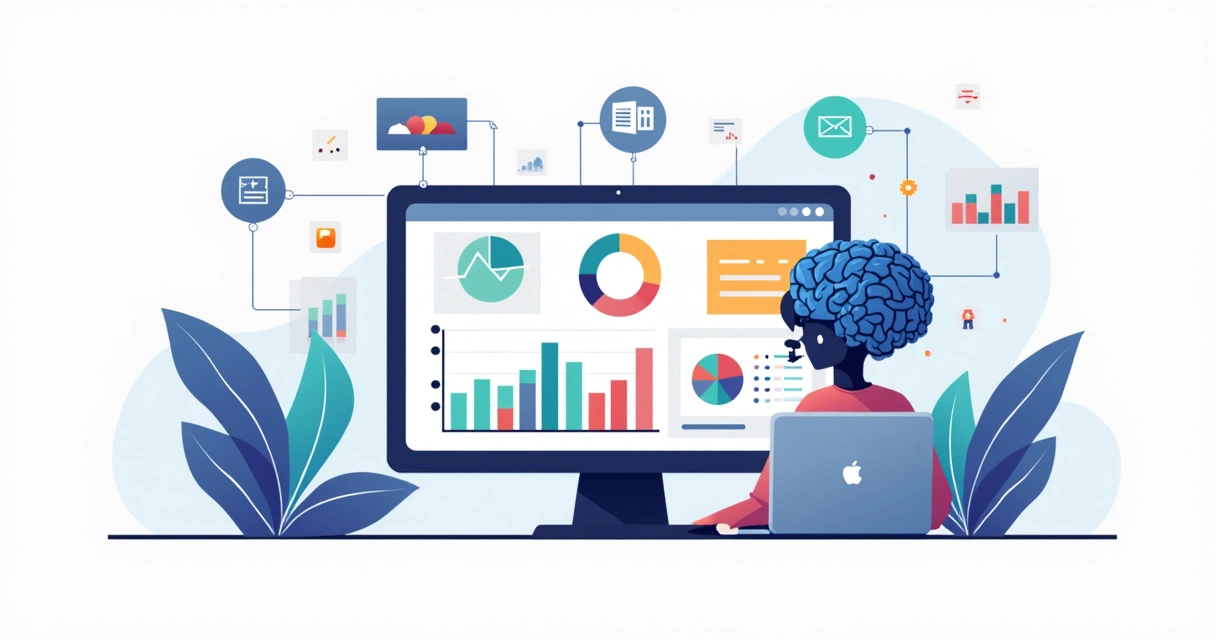
Data analysis has evolved. In a scenario where information grows exponentially, companies that can transform data into knowledge have a competitive edge. This guide provides a practical approach to how artificial intelligence (AI) transforms the entire analysis cycle: from collection to decision-making. Real-life stories, examples, warnings, recommendations, and trends are highlighted.
Artificial intelligence is redefining the future of business.
Throughout this article, you will understand the main types of analysis with AI, see how machines are already accelerating and refining strategies, and realize that accessibility no longer depends on technical teams. Tools like Sherlok demonstrate this reality by integrating complex systems without requiring programming, making automated data analysis natural and democratic.
What is data analysis with artificial intelligence?
AI-assisted analysis uses algorithms, machine learning, and advanced techniques that automate tasks and enhance the ability to spot patterns in large volumes of data. Previously, professionals faced enormous challenges organizing, cleaning, cross-referencing, and calculating metrics. Today, much of this process can be automated, including recommendations and predictions.
According to data compiled by the Center for Artificial Intelligence and Public Policy (CIAP), digital tools employing AI accelerate diagnoses, evaluations, and document reviews. The same logic applies to the corporate environment, allowing businesses to see market trends, customer engagement, and future risks in minutes.
Why have AI and data analysis become inseparable?
The volume, variety, and velocity of data exceed the traditional human capacity for processing. Managers who rely solely on manual spreadsheets or static dashboards lose agility. AI can go beyond visualization, suggesting decisions based on predictive modeling and connecting events that would be invisible to the human eye.
The utilization of National Institutes of Health databases in biomedical research demonstrates the potential of having large volumes organized in an accessible and interoperable manner.
Automated analysis: from questions to answers in minutes
Automation with AI occurs in stages. Platforms like Sherlok exemplify this ecosystem well, connecting CRMs, databases, marketing systems, and even spreadsheets from different teams.
Automatic data collection: Social media APIs, banks, and ERPs are connected to the platform, updating records without human intervention. Time-saving is one of the biggest attractions.
Intelligent pre-processing: Cleaning algorithms find errors, duplicates, missing values, and even suggest corrections based on context. Poorly formatted data can be corrected without opening line by line.
Fast and personalized analysis: With organized data, AI identifies patterns and correlations. It's as if a team of data scientists is working constantly for every question asked of the system.
Insight and visualization generation: Dynamic charts and dashboards are created in seconds. Automatic alerts and recommendations trigger notifications in internal channels, such as email or Slack.
Many questions, few answers without AI.
The main types of analysis in the data journey
The AI analysis cycle can encompass four main types. Each answers specific questions:
Descriptive analysis: Answers 'what happened?'. Summarizes past events, such as quarterly sales or website visits. Automated dashboards show peaks, drops, and evolution percentages.
Diagnostic analysis: Solves 'why did something happen?'. AI cross-references variables to understand performance causes. For example, it shows which campaign drove the most conversions in a given month.
Predictive analysis: Indicates 'what will happen?'. Machine learning models project future sales based on history and external variables, such as seasonality or industry trends.
Prescriptive analysis: Suggests 'what to do next?'. In addition to predicting, AI recommends actions: increase budget, segment leads, or change inventory distribution, always aligning decisions with objectives.
The practical impact of these analyses can be seen, for example, in sectors such as retail and healthcare. According to NIH initiatives, making data accessible to AI can accelerate medical diagnoses and outbreak predictions, while in inventory management, predicting stockouts and adjusting purchases reduces losses and generates profits.
From machine learning to strategic insight
Machine learning allows systems to improve their responses over time. The more they are exposed to new information, the faster and more accurate the analysis becomes. In companies, this translates into results such as:
Churn prediction (customer cancellation)
Dynamic product recommendation
Anomaly detection (such as transaction fraud)
Audience segmentation for campaigns
The key difference of modern systems lies in combining the ability to continuously learn with simple interfaces, where questions can be asked in natural language, without complex code. Sherlok, for example, was developed so that specialists and managers can seek answers without a technical background.

This type of resource creates an environment where questions can be as fast as decisions.
Your AI agents already know what to do in your account.
Turn them on free, no credit card.
- No credit card
- Read-only access
- Revoke it any time