
AI for Data Analysis: A Practical Guide for Businesses
Data analysis with artificial intelligence is no longer a futuristic and distant scenario. Today, it is part of the daily routine of companies of all sizes, from small retail to large industries. Whether to understand sales trends, identify hidden patterns in customer behavior, or even suggest tactical actions for marketing teams, artificial intelligence for analysis has become an indispensable tool. But, after all, how to adopt AI for data analysis in a safe, practical and efficient way within an organization? This detailed guide answers this question, bringing concepts, practical cases, and recommendations for small and medium-sized businesses.
Why has AI for data analysis gained prominence?
Until a few years ago, transforming large volumes of information into strategic decisions was a task only possible for specialized technical teams, with long hours dedicated to scripts, spreadsheets, and reports. Today, artificial intelligence offers more autonomy to teams and reduces the time lost in the search for reliable insights.
According to IBGE data, between 2022 and 2024, the percentage of industrial companies with 100 or more employees using AI jumped from 16.9% to 41.9%. This shows how such solutions quickly ceased to be an accessory to become part of the core decision-making of organizations.
Transforming raw data into action is a priority for companies that want to grow fast.
The Sherlok platform, in this context, emerges with the mission of democratizing access to advanced analytical intelligence, integrating various sources in an intuitive environment that requires no programming.
Understanding the different types of data analysis
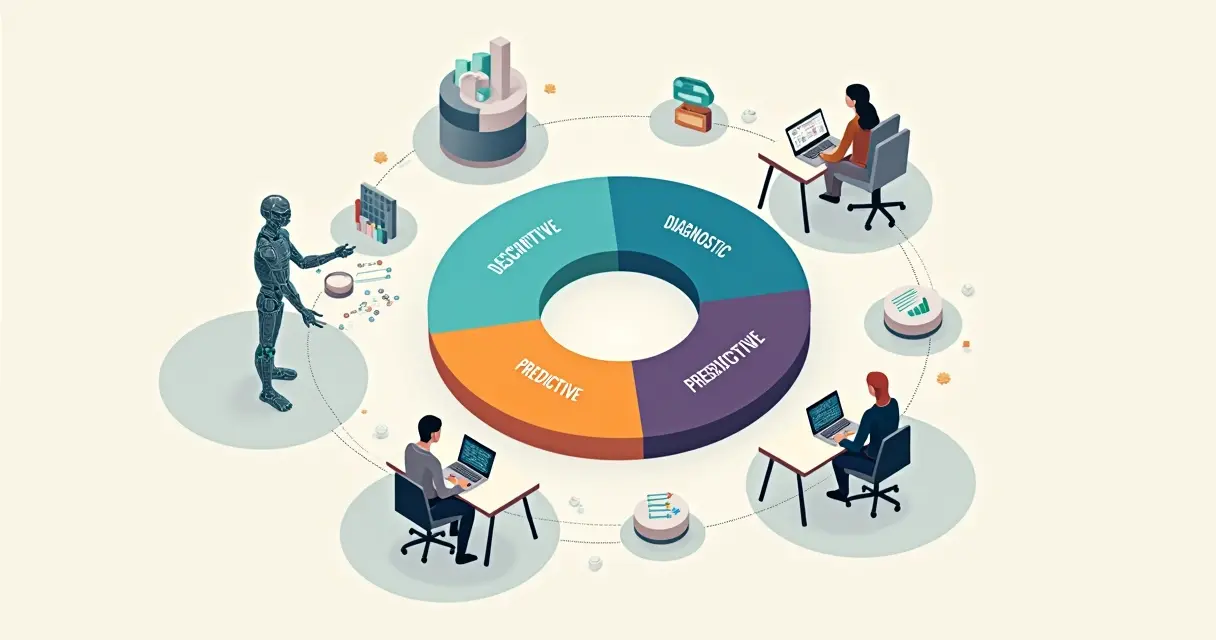
Not all data analysis is the same. Learning to differentiate the types of analysis is the first step to aligning expectations and results when adopting AI in a company.
Descriptive analysis: what happened?
Descriptive analysis is the starting point for clearly understanding past results. It seeks to answer questions such as: What was the revenue for the month? How many users accessed a website in a given period? Which products sold the most last week?
AI tools can accelerate the collection of this data, automating reports and cross-referencing different sources (such as sales, CRM, and social media). The result is an objective and reliable overview, saving team time and avoiding common manual compilation errors.
Diagnostic analysis: why did it happen?
After knowing "what happened," the next step is to know "why it happened." Diagnostic analyses delve deeper, seeking correlations and causes for each identified event.
AI makes it possible to identify patterns and explanations that, in traditional scenarios, would go unnoticed. Imagine, for example, an e-commerce where sales dropped in September. AI can correlate this drop with the start of school, changes in the product mix, or the intensity of competitor campaigns on social media.
Predictive analysis: what could happen?
Predictive analysis uses mathematical models and machine learning techniques to forecast possible future scenarios. This ranges from revenue estimates to identifying customers at higher risk of churn, or predicting demand for product categories.
With the addition of AI, projections become more accurate and can be updated in real-time as new data is included in the company's databases.
Prescriptive analysis: what should I do?
In addition to predicting the future, companies want practical guidance on "what to do next." Prescriptive analysis goes beyond prediction, indicating which actions maximize results or minimize losses.
Prescriptive AI can recommend campaign adjustments, suggest customer segmentation, or show alternative service routes. Soon, with the evolution of AI agents, such recommendations may even be automatically executed by the platform, speeding up responses and reducing risks due to delays or human errors.
How to integrate diverse data sources without complications?
A company's information is spread across CRMs, ERP systems, advertising platforms, spreadsheets, databases, and digital marketing environments. The power of artificial intelligence is to connect all these points and provide answers in one place.
Modern platforms, like Sherlok, eliminate code and manual integrations, connecting media, sales, SEO tools, spreadsheets, and databases on a single dashboard. This allows companies to centralize their intelligence, cutting through noise and accelerating decision-making.
Practical benefits of this integration
Drastic reduction in time spent searching for data
Reduction of manual consolidation errors
Ease of updating indicators in real-time
Possibility of cross-referencing results from different areas, such as sales & marketing
Automatic feeding of dashboards and reports
According to debates at the National Seminar on Workforce Sizing, the integration and strategic use of data are trends in both large companies and public sector organizations, becoming a competitive differentiator.
Bringing multiple sources together: in practice
Imagine a marketing manager who wants to understand how Google Ads actions affect lead generation in their CRM. They connect the ad accounts and the CRM to the platform, define the desired indicators, and in moments, artificial intelligence identifies the impact of each campaign on sales, even suggesting which ads to pause and which to scale.
Automation: how does AI perform repetitive and analytical tasks?
Automating tasks with AI means freeing up teams to think strategically, while analytical and operational routines are handled by algorithms.
Many processes, such as extracting reports, applying complex formulas, or cross-referencing multiple databases, can now be reliably delegated to artificial intelligence. The result is time freed up in marketing, sales, and data departments, without compromising control and without requiring advanced scripting knowledge.
Key tasks that can be automated
Instant generation of reports for sales, finance, and marketing
Periodic update of dashboards with live indicators
Triggering automatic alerts and notifications when anomalies or trends are identified
Automatic recommendations for actions based on performance
Sending cross-referenced data to different teams or areas without rework
, as an integrated hub, can be configured to gather these tasks into automatic workflows, leaving the team focused on the business's most strategic challenges.
AI Prompts: how to communicate with the machine without being technical?
A differentiator of modern platforms is allowing conversations in natural language, dispensing with technical terms. That is, just ask, and AI delivers analyses, suggestions, or even executes tasks.
Examples of useful prompts for teams that want quick action:
What was the growth in average ticket per sales channel over the last three months?
Which customer segment has the highest repurchase rate and how can I increase that number?
Notify me if conversions drop during the weekend.
Suggest changes to the campaign with the highest cost per lead.
These commands, in environments like Sherlok, transform the ordinary professional into an advanced analyst, without complicating the process.
AI Agents: the future has already begun
In the next wave of AI for data analysis, intelligent agents will emerge. They will be able to receive recommendations from the platform itself and execute them, reducing the delay between detection and action.
Sherlok, for example, is already designing this functionality, which will give managers the freedom to delegate entire operations to AI, with clear rules and real-time monitoring.
Governance, ethics, and privacy: challenges for the use of AI in data
As analyses are automated and sources integrated, concerns about responsible use, data protection, and transparency of results have also grown.
To ensure a secure environment when adopting AI for data analysis, companies must strengthen governance policies and be attentive to data protection legislation.
What to prioritize when adopting AI in data?
Verifying the origin and integrity of data processed by platforms
Defining clear access roles, avoiding unnecessary exposure of sensitive information
Recording the entire history of automated actions for auditing
Maintaining transparency about how and what data will be used by AI
Ensuring that the solution complies with LGPD (General Data Protection Law) and international standards
Modern organizations have reviewed internal processes, including data usage consent and algorithmic results validation, to ensure impartiality and protect customers and the business.
Ethical decisions in model building
When analysts configure AI for decision-making, they need to avoid biases, that is, ensure that the models do not point to discriminatory, unfair, or outdated information. Periodically auditing algorithms, validating samples, and maintaining a testing environment are recommended practices.
AI-based decisions are only reliable when data governance is respected.
In this context, Sherlok provides detailed analysis records, operational documentation, and the ability to configure rules and access levels, supporting companies on an ethical and transparent path.
Practical applications for marketing, sales, and data teams
Each area of the company can benefit differently from AI for data analysis, according to its daily challenges.
Marketing: segmentation, recommendations, and attribution
The marketing team benefits from using AI to identify consumption trends, predict customer behavior, and evaluate campaign ROI in real-time.
Rapid identification of segments with the best financial return
Campaign adjustments based on time, user profile, or channel
Automation of recommendations on budget and campaign prioritization
Clear attribution of results by channel, theme, or team
By connecting Google Ads, Facebook, and the CRM system in the same platform, the manager has complete resources to visualize, act upon, and quantify results, all in minutes. AI even suggests unexplored segments, providing new ideas for strategic growth.
Sales: prediction and automatic qualification
Sales teams save time by receiving leads already classified and prioritized by AI, according to conversion probability. This allows for a more personalized approach, optimizing the team's time.
Forecast of closing by representative, month, or product line
Automatic classification of potential customers according to behaviors and historical patterns
Automatic alerts for teams about possible drops or opportunities
AI can also measure pipeline scarring, anticipate bottlenecks or slower cycles, and enable alignment between marketing and sales using simple language, without the need for manual integration.
Data teams: experimentation and agility without programming
For data scientists and analysts, intelligent platforms offer a structure to create experiments, validate hypotheses, and test models quickly, without requiring advanced programming language knowledge.
Rapid hypothesis testing using intelligent prompts
Creation of experimental dashboards that adapt to use
Information consultation with natural language
Cross-referencing data from internal and external sources automatically
The centralization proposed by environments like Sherlok reduces time spent on data preparation, delivering agility to respond to business demands.
Managers: control, efficiency, and focus on results
For the manager, AI for data analysis provides clarity on indicators, allowing them to demand results, adjust goals, and monitor performance in real-time, with automatic alerts in case of significant deviations.
Synthesized visualization of key business metrics
Proactive AI alerts about deviations
Comparisons between areas, branches, or periods
‘Making quick, informed decisions is more valuable than waiting for lengthy manual reports,’ the Sherlok implementation team often repeats to leaders of medium-sized companies.
Recommendations for small and medium-sized businesses: how to get started?
Not every company needs to start with large predictive analytics projects or complex AI agents. Progress can be made in stages, generating value from the outset with small automations.
Practical steps for adopting AI in data
Identify the main immediate problem. Is it delayed reports? Lack of campaign monitoring? Difficulty identifying customers with the highest potential?
Centralize data sources. Bring together sales, leads, financial spreadsheets, and digital platforms in a single dashboard.
Automate the most recurring reports. Delegate to AI what currently takes the most time, such as data extraction and cross-referencing.
Define intelligent prompt routines. Create automated programmed questions ("Which sales were lost yesterday?"), allowing for immediate gains in agility.
Implement automatic alerts. Don't wait to discover problems by looking at old reports. Let AI notify you when sudden changes occur in indicators.
Form small pilot teams. Choose an area or team to be responsible for the initial validation period. Gradually expand use cases.
Ensure training and governance. Guide the team on best practices in governance, ethics, and privacy from the beginning of the project.
According to the experience of digital adoption consultants, when AI is introduced in such short, directed cycles, the return is felt within the first few weeks.
Using case studies for inspiration
In the article Data analysis with artificial intelligence in the corporate context, you can find detailed examples of companies that took their first steps and have already achieved greater agility and clarity from the use of specialized platforms.
Tool options and learning paths
Professionals in small and medium-sized businesses find alternatives for training and updating on the topic. Articles such as Machine learning for business decisions and Data analysis with AI for business decisions offer reflections on possible paths, challenges, and points of attention when choosing the best automation model.
In other content on data analysis and indications of the best data analysis tools, the reader can learn more options and dynamics for adopting AI and transforming data into results in a practical way.
Conclusion: artificial intelligence has made analysis accessible to all
The advancement of artificial intelligence has moved data analysis from the technical to the strategic field. It allows decision-makers, from any area, to act with speed, precision, and autonomy, accelerating results in marketing, sales, finance, and operations, even in medium or small-sized companies.
Responsible adoption, attentive to ethics and governance, and the choice of solutions that integrate multiple sources in intuitive environments, such as Sherlok, create a positive spiral of innovation and growth. The future of business is built today by automating, learning, and democratizing data analysis for all levels of the organization.
Want to know how your company can transform data into quick and secure actions? Explore the solutions, cases, and educational materials about intelligent data analysis on the Sherlok website and see how your company's next result can begin with a more informed decision.
Frequently asked questions about AI for data analysis
What is AI for data analysis?
AI for data analysis is the use of algorithms and automatic models capable of transforming raw data into valuable information for decision-making. It interprets large volumes of records, identifies patterns, offers recommendations, and even executes routines to free up the time of employees in areas such as marketing, sales, and data.
How to apply AI in data analysis?
Applying AI in data analysis starts with integrating the company's main information sources into a single platform, followed by automating reports, alerts, and recommendations through simple commands. Case studies show that companies gain value by centralizing sales, marketing, and operations, allowing AI to process, interpret, and suggest practical actions based on business objectives.
What are the benefits of AI for businesses?
The main benefits are: agility in market responses, reduction of human errors in analyses, automation of reports and alerts, prescriptive recommendations for campaigns and sales, greater control over data, and democratization of access to analytical intelligence for teams with different backgrounds.
How much does it cost to implement AI in data?
The implementation cost varies according to the company size, number of data sources, and desired level of automation. Cloud solutions and intuitive platforms like Sherlok allow for gradual entry, without large initial investments in consulting or programming, making advanced data analysis accessible even for smaller businesses.
What are the best AI tools for analysis?
The best platforms are those that combine easy integration between systems, AI-driven automation, natural language for prompts, and advanced data governance. Sherlok stands out by bringing these elements together in a simple and secure environment, ready to connect diverse sources and generate immediate value, as presented in comparisons and expert articles.
Your AI agents already know what to do in your account.
Turn them on free, no credit card.
- No credit card
- Read-only access
- Revoke it any time