
AI Agents: What They Are and What They Change for Business
Gartner went through the thousands of vendors selling themselves as "agentic AI" platforms and counted how many actually deliver agent capabilities. The answer: roughly 130. The rest practice what the firm calls agent washing: relabeling old chatbots, RPA bots, and virtual assistants with the buzzword of the moment.
That matters because "AI agent" became the most used, and most misused, term in software sales through 2025 and 2026. If you run marketing, sales, or operations, someone has already tried to sell your company an agent. And the odds that this agent is a chatbot with a new script are uncomfortably high.
The direct answer: AI agents are systems that take a goal, plan the necessary steps, execute actions in other tools (querying databases, triggering tasks, updating records), and check their own results, with only occasional human supervision. The core difference from a chatbot: a chatbot answers questions; an AI agent completes tasks.
What is the difference between an AI agent and a chatbot?
The classic chatbot is reactive. It takes a question, looks up a knowledge base or follows a script, and returns an answer. That is the whole show. If the answer is wrong, it never notices; if the task spans three different systems, it never reaches the second one.
An agent runs in a loop. It understands the goal ("figure out why cost per lead spiked this week"), decides which data it needs, pulls that data from the sources, analyzes it, and only then responds or acts. If the first path fails, it tries another. That ability to plan, use tools, and self-correct is what separates the two categories, not how polished the text on screen looks.
| Trait | Chatbot | AI agent |
|---|---|---|
| What it does | Answers questions | Completes tasks end to end |
| Initiative | Only reacts to what you type | Plans steps and decides what to do next |
| Tool access | Fixed knowledge base | Queries systems: spreadsheets, CRM, ad platforms, SQL databases |
| When it fails | Never notices the error | Checks the result and tries another path |
| Data example | "What are your business hours?" | "Cross campaign costs with CRM sales and tell me what to pause" |
There is a useful middle ground the market calls a copilot: the AI suggests, you execute. Many companies asking for "an agent" actually need a good analysis copilot. Nothing wrong with that; autonomy is a means, not a trophy.
How an AI agent works in practice
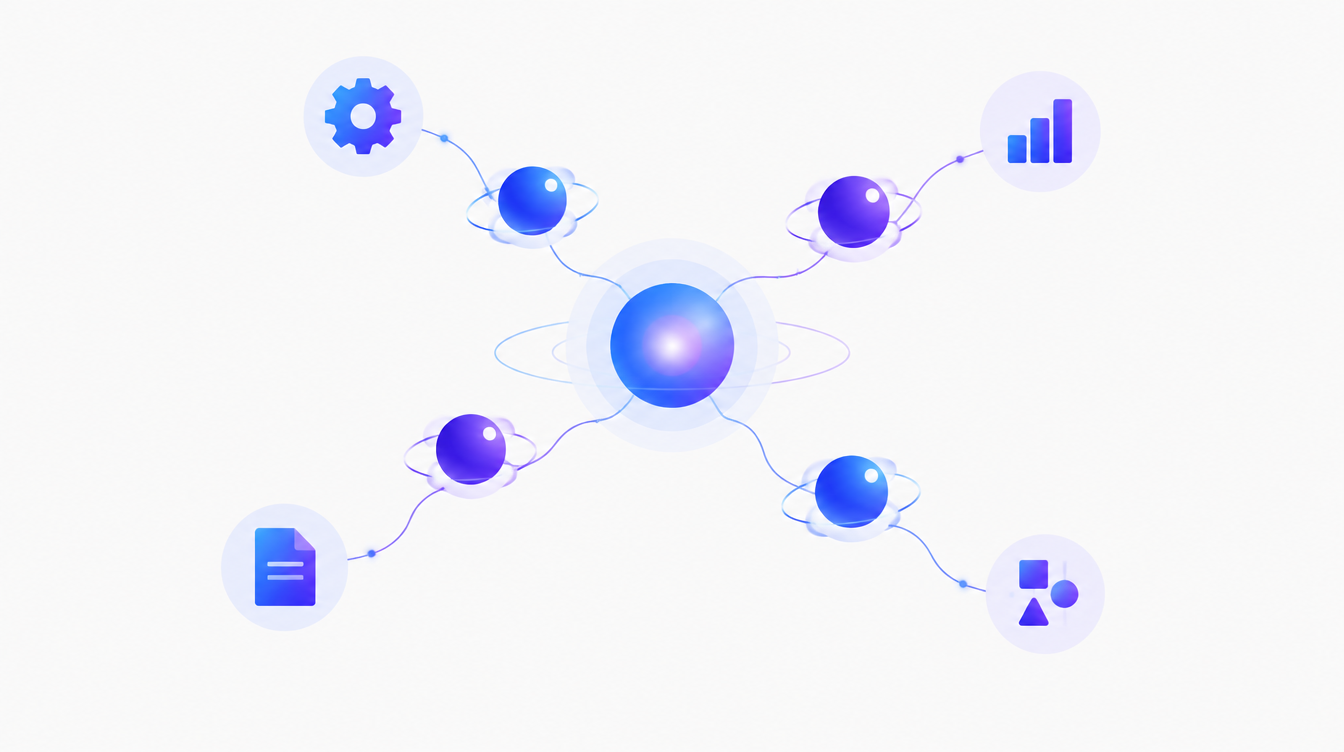
Behind the label, nearly every serious agent runs the same four-step loop. First, it receives a goal in natural language. Second, it breaks that goal into a plan: which data to fetch, in what order, with which tools. Third, it executes: queries the spreadsheet, runs the SQL, pulls the report from the ad platform. Fourth, it checks whether the result answers the goal. If it does not, it goes back to the plan and adjusts.
Notice what this loop demands: access to data sources. An agent with no connection to the CRM, the ad platforms, and the finance system is an intern locked out of the office. That is why companies with data trapped in silos stumble before even picking a tool: the agent plans just fine, but has nowhere to act.
Where AI agents already deliver results with data
The most mature use cases today are not the most cinematic ones. They are repetitive analytical tasks with structured data and a clear definition of success. Three plausible examples:
A mid-sized e-commerce operation. An agent monitors Meta and Google campaigns daily. On a Monday it detects that one campaign's ROAS dropped from 4.2 to 1.8, cross-references inventory, and finds that the ad set's best seller sold out over the weekend. It suggests pausing the ad set and reallocating budget. The manager approves in one click. Without the agent, that diagnosis would have surfaced by Thursday.
A marketing agency. Month-end closing means collecting data from 4 platforms for 20 clients. An agent pulls the numbers, computes variations, flags the top 3 highlights per account, and drafts the client results report. The analyst reviews and adds context instead of spending two days copying and pasting.
A B2B sales operation. An agent crosses the CRM pipeline with historical data and flags which deals are going cold based on interaction patterns, something we covered in our guide to AI for sales. The team works a prioritized list instead of trusting gut feel alone.
The pattern across all three: the agent does not replace the decision, it shortens the path to it. A human still decides what gets paused, rewritten, or prioritized.
What the numbers say about agent adoption
Two things are happening at once, and both are true. The first is rapid adoption: Gartner projects that 40% of enterprise applications will include task-specific AI agents by the end of 2026, up from less than 5% in 2025. Pointing the same way, McKinsey's State of AI survey shows 40% of large companies (over $1 billion in revenue) scaling AI agents, up from 27% the year before.
The second is disappointment: Gartner itself predicts that over 40% of agentic AI projects will be canceled by the end of 2027, citing escalating costs, unclear business value, and inadequate risk controls. It is the same report behind the 130 legitimate vendors mentioned at the top.
How can both be true? Scope. Projects that automate one well-defined analytical task tend to pay for themselves. Projects promising "an agent that runs the whole operation" pile up cost and risk until someone pulls the plug. In practice, the ambition of the label tends to be inversely proportional to the return.
When an AI agent is not the answer
Three situations where the hype gets in the way. First: messy data. If every team keeps its own spreadsheet and no two numbers match, an agent will simply automate the confusion at higher speed. Clean house first; a simple data integration effort beats any AI here.
Second: high-stakes, hard-to-reverse decisions. Approving credit, letting people go, repricing an entire portfolio. Here AI should inform, not execute. The cost of one autonomous mistake outweighs any speed gain.
Third: when good on-demand analysis already solves it. Many companies do not need an autonomous system running 24/7; they need fast, reliable answers when the question comes up. In that scenario, AI-powered analysis tools like the ones in our guide to AI in digital marketing deliver 80% of the value with 20% of the complexity.
Frequently asked questions
What are AI agents and what are they for?
They are AI systems that take a goal, plan the steps, execute actions in other tools, and verify the outcome. They are built to complete tasks end to end, such as monitoring campaigns, assembling reports, or cross-referencing sales data, not just to answer questions.
What is the difference between an AI agent and a chatbot?
A chatbot reacts to questions with scripted or knowledge-base answers. An agent plans, accesses external systems, executes actions, and corrects itself when the result misses the goal. In short: a chatbot talks, an agent works.
Are AI agents reliable?
It depends on scope and controls. On analytical tasks with structured data and human review, accuracy is high. On high-impact autonomous decisions, risk grows: Gartner lists inadequate risk controls among the top reasons agentic projects get canceled. Start with the agent suggesting, not executing.
What is agent washing?
It is the practice of relabeling existing products, such as chatbots, RPA, and virtual assistants, as "AI agents" without real ability to plan and execute tasks autonomously. Gartner estimates that only about 130 of the thousands of vendors on the market deliver genuine agent capabilities.
Do I need to know how to code to use AI agents?
Less and less. Current platforms let you connect data sources and give instructions in natural language. Coding is still needed for heavily customized agents or non-standard integrations, but the typical analytical use case already works without it.
Start with the data, not the label
The right question for 2026 is not "how do I buy an AI agent?" but "which repetitive, data-driven task with a clear definition of success is eating my team's hours?". Answer that and the technology choice becomes obvious; ignore it and you become a line in Gartner's cancellation statistics.
If the task consuming your team is analyzing marketing and sales data scattered across platforms, that is exactly what Sherlok solves: connect Meta Ads, Google Ads, GA4, your CRM, and spreadsheets, ask questions in plain language, and get the analysis done, with AI doing the work of crossing and interpreting the numbers for you.
Your AI agents already know what to do in your account.
Turn them on free, no credit card.
- No credit card
- Read-only access
- Revoke it any time