
Practical Guide to Data AI: Industrial Applications
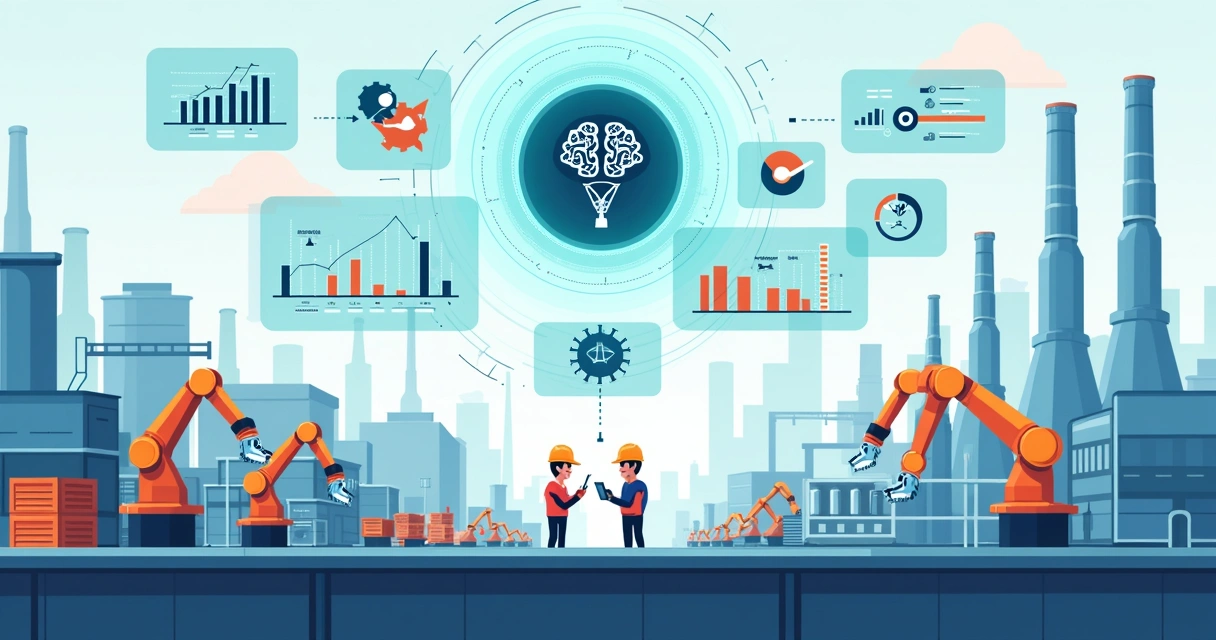
Every day, the volume of information generated by factories and companies grows at an astonishing rate. Machines, sensors, and management systems feed databases that, without proper organization or analysis, become just lost numbers. The field of artificial intelligence focused on data analysis then emerges as a strategic partner for the industrial sector, promoting smarter decision-making and optimizing end-to-end processes.
Smart industry transforms data into real opportunity.
This guide presents the main scenarios in which AI-based data analysis solutions change industry routines. These are concrete examples, implementation steps, frequent challenges, case studies, and practical suggestions, always seeking clarity and objectivity, without unnecessary technical jargon. At the end, there is a frequently asked questions section to aid understanding. At various points, it will be possible to notice how features similar to those offered by Sherlok already have a significant impact on different productive areas of the industrial sector.
Why has data analysis with AI become indispensable in industry?
Industrial decision-making cannot be based solely on experience or intuition. Production lines, maintenance, and purchasing management require precision. Correct information, at the right moment, makes the difference between loss and profit, delay or rapid delivery, rework or technological advancement. With AI, large databases cease to be passive and instead offer automatic responses, identify patterns, and suggest decisions.
The gains are reflected in various areas: asset maintenance, quality inspection, logistics control, workplace safety, raw material usage, energy, and rapid responses to unforeseen events.
Main applications of data AI in the industrial sector
Practical uses vary, each addressing specific challenges of factories and industrial organizations:
- Predictive maintenance: Detects potential failures before they become costly machine downtimes.
- Industrial automation: Automatically adjusts processes according to real-time data.
- Digital twins: Creates virtual replicas of factories for simulations and adjustments without risk.
- Supply chain management: Anticipates demands and optimizes inventories.
- Quality inspection: Automatic identification of deviations and defects in products.
Predictive maintenance: more availability, less cost
Planned maintenance with AI allows monitoring parameters such as vibration, temperature, electrical current, and other signs of wear. Algorithms analyze historical trends and current patterns. Thus, they recommend the ideal time for maintenance, avoiding both unexpected downtimes and unnecessary interventions.
An automotive industry, using predictive analytics, increased the availability of its lines by 12% and reduced maintenance costs by 23%, according to industry studies.
Smart industrial automation: real-time decisions
Sensors connected to AI-based systems automatically adapt process variables, such as pressure, temperature, and speed, according to variations identified in continuous operations. This ensures uniform quality, reduces waste, and promotes rapid reaction to unexpected deviations. Simple platforms, such as Sherlok, already provide integration between machines, databases, and dashboards without requiring programming.
Digital twins: testing changes without real impact
A digital twin is a virtual representation of the industrial plant, including equipment and processes. By feeding the model with sensor data and operational history, AI is used to simulate layout changes, test different parameters, and predict results of adjustments, without risks to the real environment.
Innovation comes from testing alternatives even before physically implementing them.
This approach supports investment decisions, expansion planning, and early detection of bottlenecks.
Supply chain management: inventory as an ally
The management of inputs in industry requires predictability and quick reaction to shortages or excesses. With AI, algorithms analyze orders, deadlines, delivery times, and average consumption to generate accurate forecasts, issue alerts, and suggest automatic replenishments. Platforms that integrate information from ERPs, CRMs, and databases make the operation dynamic, reinforcing integrated management.
Automated quality inspection
Visual analysis with image and AI, for example, already allows identifying defects in welds, cracks in parts, and millimetric size deviations in seconds. Smart sensors and cameras prevent rework and waste by detecting non-conforming items before they advance on the production line.

Automated inspection with AI helps ensure high quality standards, even in large-scale production.
Concrete benefits of data AI applied to industry
By applying AI-based data analysis solutions, the productive environment undergoes easily noticeable transformations:
- Increased machine availability and fewer unexpected downtimes.
- Reduced waste of raw materials and energy.
- Precise quality control, with standardized products.
- Automatic adjustment of processes in real time.
- Decreased operational and maintenance costs.
- Integrated business vision, with centralized information.
In addition, strategic impacts are felt, such as increased customer trust, improved financial planning, and the ability to scale quickly with less risk.
Automating data analysis has become a differentiator for those who want to gain agility without losing control of the production process.
How to implement data analysis with AI in the industrial environment?
The success of technology application involves a clear and accessible roadmap of steps:
- Assessment of needs and objectives:
Before any investment, it is essential to map the process bottlenecks, performance goals, and priority areas.
- Choice of tools and platforms:
At this point, complete platforms, such as Sherlok, stand out for allowing connections between legacy systems, databases, spreadsheets, and management software, in addition to facilitating visualization and insight generation.
- Team training:
Investing in practical training is essential to get the most out of the new technology. Training operators, managers, and analysts ensures that digital transformation is not restricted to the IT sector.
- Measurement of results:
Defining performance indicators, such as reduction of downtimes, energy savings, or increased production, is what ensures the sustainability of the initiative.
The implementation of data AI should be done gradually, with controlled tests and progressive expansion according to proven results.
Main challenges and how to overcome them
Despite the gains, the industrial environment faces some obstacles in adopting artificial intelligence applied to data analysis:
- Information security: The volume and sensitivity of industrial data require strict protection protocols and restricted access.
- Integration of old systems: Legacy machines and software may not easily communicate with new solutions, requiring connectors and customizations, offered by platforms such as Sherlok.
- Training and resistance to change: Untrained teams or those resistant to new technologies tend to delay gains. Clarity of objective and demonstration of benefits are strategies that work in most cases.
- Incorrect result measurement: Without clear indicators, it becomes difficult to justify or evaluate the investment in AI.
Overcoming these challenges depends on clear communication, balanced investment, close monitoring by management, and, especially, the choice of accessible and flexible platforms.
Examples of typical use: data AI changing the industrial scenario
To inspire, it is important to show how companies of different sizes have used AI in their industrial data to achieve advances:
- A beverage manufacturer that connected sensors on lines and predicted conveyor belt failures, avoiding hours of downtime during peak season.
- An energy company that used AI to adjust production according to predicted consumption, reducing waste and costs.
- A textile industry that implemented cameras on cutting and sewing lines to identify failure patterns and adjust processes, improving final quality.

When data collection is connected to automated analysis, the company can anticipate problems and identify new growth opportunities.
Readers who wish to delve deeper into examples and concepts can access content such as the article on data analysis with AI for business decisions and the complete data analysis category on the Sherlok portal, both offering real experiences and tips on integration and analysis.
How to align industrial AI with business strategy
It is increasingly common for the productive sector to seek not only to produce more, but also to make decisions based on clear indicators, reduce risks, and increase competitiveness. At this point, aligning AI with management brings direct benefits:
- Allows rapid responses to unexpected problems, with automatic alerts.
- Fosters a culture of continuous improvement, with recommendations based on concrete data.
- Generates accessible reports and dashboards for senior management, not just for data engineers.
- Strengthens the company's predictive vision: instead of acting only in the present, the business anticipates trends.
It also helps connect marketing, sales, customer service, and production data in a single environment, something already observed in Sherlok's features, which adapt to different industrial sizes and maturities.
To guide this journey, the content Machine Learning: how to apply data for business decisions presents additional ways to integrate AI into strategy.
The journey of continuous digitalization
The digital transformation of industry is no longer a one-time event, but a continuous process. Investment in artificial intelligence for data analysis has become one of the most rational steps for those seeking sustainable growth in a competitive market.
Solutions like Sherlok show that you don't need to be a multinational to benefit from AI: the ease of integrating different data sources, suggesting automatic actions, and generating practical reports is within reach of industries of all sizes.
Other topics such as artificial intelligence and Big Data in companies also offer resources to deepen the integration of technology into the productive routine.
Conclusion
Data analysis with AI is already part of the present of industry, boosting performance, controlling costs, and supporting strategic decisions. From the factory floor to senior management, applying intelligence to information is what distinguishes successful companies. In this context, accessible, customizable, and secure platforms, such as Sherlok, enhance digital transformation without requiring advanced programming knowledge.
The industry that wants to grow needs to learn to transform every piece of information into concrete action. Sherlok invites managers and technical teams to get a close look at intelligent solutions that connect data, integrate systems, and promote automatic recommendations. Schedule a demonstration, see in practice how AI can boost the results of your industrial operation, and be part of the data revolution!
Frequently asked questions about data AI for industries
What is data AI for industries?
Data AI for the industrial sector brings together artificial intelligence tools and algorithms that transform large volumes of operational information into automatic analyses, forecasts, and recommendations with a productive focus. They can be applied in maintenance, production, quality inspection, supplies, and administration, supporting fact-based decision-making.
How to apply data AI in industry?
The first step is to map needs and define clear objectives. Then, it is necessary to choose platforms that connect machines, databases, and management systems, as Sherlok does, ensuring automatic collection and analysis. Success depends on training the team to read and act on the generated insights. Practical tests and progressive expansion will allow adjusting the solution according to the observed results.
What are the benefits of industrial AI?
Among the main gains are the reduction of operational costs, increased equipment availability, better quality control, faster response to failures, predictability in input consumption, and automatic reports for decision support. In addition, AI contributes to the business's analytical capability, making it more competitive and agile.
Is it worth investing in data AI?
Investing in artificial intelligence data does not just mean following a trend, but obtaining concrete and measurable returns. Companies that apply AI to their data observe cost reductions, fewer downtimes, and unprecedented growth opportunities. The process makes the company less dependent on intuition and more connected to its own performance.
Which industries use data AI the most?
The automotive, food, chemical, energy, and textile sectors are among those that lead investments in AI for data analysis, but companies in all segments, including manufacturing and logistics, have incorporated this technology to maintain competitiveness. The increasing ease of integration allows small and medium-sized companies to also adopt advanced practices with solutions like Sherlok.
Your AI agents already know what to do in your account.
Turn them on free, no credit card.
- No credit card
- Read-only access
- Revoke it any time