
What Is ETL? Extract, Transform, Load Explained Simply
Every Monday morning, someone at your company opens four tabs: Meta Ads Manager, Google Ads, GA4, and the sales spreadsheet. They copy numbers, paste them into a fifth spreadsheet, and check whether the total matches finance. It doesn't. They redo it. Two hours later, out comes a report that was already stale at birth.
That ritual has had a known diagnosis for decades: data scattered across systems that don't talk to each other. And the classic technique for fixing it, moving data from multiple sources into one place automatically and reliably, goes by the acronym ETL.
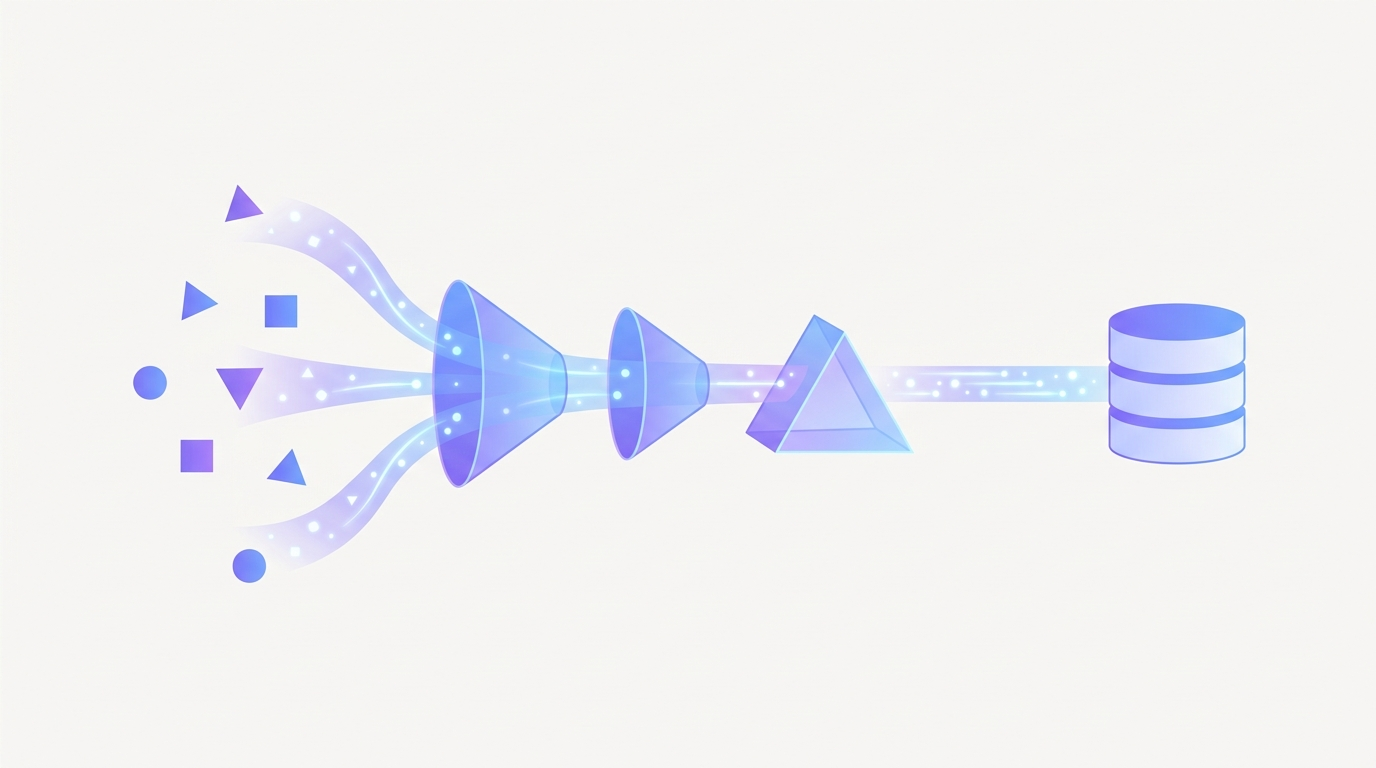
ETL stands for Extract, Transform, Load. It's the process that collects data from different sources (CRM, ad platforms, spreadsheets, databases), cleans and standardizes that data, and deposits it in a single destination, usually a data warehouse, ready for analysis. In ELT, the more modern variant, transformation happens after loading, inside the destination itself.
What each letter of ETL does in practice
Think of a restaurant kitchen. Extraction is the trip to the market: you fetch ingredients where they live. Transformation is the prep work: washing, peeling, cutting everything to the house standard. Loading is storing each clean, labeled item in the walk-in fridge, ready to become a dish during service. No chef cooks straight from the market stall. Analyzing data straight from the raw source is the same kind of recklessness.
Extract
This is collecting raw data where it lives: the Meta Ads API, the CRM export, the ERP's SQL database, that targets spreadsheet only the sales manager updates. Extraction can run in batches (every day at 6 a.m., say) or near-continuously. The challenge here is less technical than it is about discipline: every source has its own format, rate limits, and quirks.
Transform
This is where the real work lives. Dates arrive as 08/12/2026 in one source and 2026-08-12 in another. One platform records "New York", another records "NY". Cost comes in cents from the API and in dollars from the spreadsheet. The same customer shows up three times under different spellings. Transformation fixes, standardizes, deduplicates, and joins tables: cost per campaign on one side, revenue per order on the other, matched by a shared identifier.
Load
This is depositing the result in a central destination: a data warehouse like BigQuery or Snowflake, a PostgreSQL database, or even a master spreadsheet in smaller operations. From there, dashboards, analyses, and AI models query a single source, with numbers that agree with each other.
A worked example with real numbers
An online cosmetics store spends $38,000 on Meta Ads and $22,000 on Google Ads in a month. Meta's dashboard reports $152,000 in attributed revenue (a 4.0 ROAS). Google reports $99,000 (4.5 ROAS). Together that would be $251,000. But actual site revenue, according to the ERP, was $210,000 for the period, organic sales included.
The platforms aren't lying: each claims conversions the other also claims. Anyone reading only the native dashboards adds up double-counted revenue and concludes the blended ROAS is 4.2. With an ETL pipeline joining both platforms' costs against real orders from the ERP, the math changes: $210,000 in revenue over $60,000 in media is a MER of 3.5. The gap between 4.2 and 3.5 is the gap between scaling budget comfortably and scaling at the edge of your margin.
This kind of distortion is expensive in aggregate. Gartner estimates that poor data quality costs organizations an average of $12.9 million per year. Your company doesn't need to be that size to feel the proportional version of the problem: a wrong budget decision is a wrong budget decision at any scale.
What's the difference between ETL and ELT?
The order of the steps. In classic ETL, data is transformed on an intermediate server before entering the destination. In ELT, raw data is loaded first and transformed afterwards, inside the data warehouse itself, usually with SQL.
ELT became the market standard for an economic reason: cloud warehouses like BigQuery and Snowflake made it cheap to store and process raw data at the destination. Keeping the raw data has a practical advantage few people appreciate at first: when a business rule changes (and it will), you reprocess the entire history without re-extracting anything.
| ETL | ELT | |
|---|---|---|
| Where transformation happens | Before loading, on an intermediate server | After loading, inside the warehouse |
| Raw data preserved | Usually not | Yes, available for reprocessing |
| When it makes sense | Sensitive data that must be masked before loading (privacy laws), low-capacity destinations | Cloud warehouse, evolving business rules, SQL-fluent teams |
| Typical tools | Talend, Pentaho, SSIS | Fivetran or Airbyte + dbt |
In practice, for most small and mid-sized businesses this choice matters less than it seems. What matters is having unified, trustworthy data; whether transformation runs before or after loading is an implementation detail your tooling resolves for you.
When does a small business actually need ETL?
Not on day one. With a single data source and a handful of reports, a spreadsheet does the job. The problem arrives with growth, and it tends to announce itself with clear signs, much like the ones we listed in 5 signs your company needs to integrate its data:
- You manually cross-reference more than three sources (ads, CRM, finance, spreadsheets) every week.
- Building the monthly report eats hours from someone whose time is expensive.
- Marketing and finance present different numbers for the same metric in the same meeting.
- Decisions wait for days because "the report isn't ready yet".
A classic industry data point explains the hidden cost: in a CrowdFlower survey published by Forbes, data professionals reported spending around 80% of their time collecting, cleaning, and organizing data, and only the remainder analyzing it. When the person doing this at your company is a marketing analyst or the founder, the waste is identical, just without "data engineer" on the badge.
Honesty about the traditional route is due here: building your own pipeline, with a data engineer, a warehouse, and orchestration tools, rarely pays off below a few million in annual revenue. It's the right solution to the right problem at the wrong size. The most common mistakes on that journey are mapped in the data management mistakes that stall growth.
ETL tools: from scripts to clicks
The market organizes into three layers. At the base, open-source tools like Airbyte and Meltano: flexible, free at the source, but they demand technical staff to operate. In the middle, managed services like Fivetran, Stitch, and Hevo, which sell ready-made connectors by subscription and take maintenance off your plate. At the top, analytics platforms that embed the integration: you connect your accounts and the ETL layer becomes invisible.
One particular case raises frequent questions: Power Query, inside Power BI and Excel, is a desktop-scale mini-ETL. It extracts from multiple sources, transforms through a visual interface, and loads into the report's data model. For an individual report it works well; as a company's central data infrastructure, it hits limits in volume, scheduling, and governance. We compared the options in the best data analysis tools for businesses.
Frequently asked questions
What are the steps of the ETL process?
Three: extract (collect raw data from the sources), transform (clean, standardize, deduplicate, and join tables), and load (deposit the result in a central destination, such as a data warehouse). Real pipelines also include validation and monitoring steps to detect when a source breaks or changes format.
What is ETL in Power BI?
In Power BI, the ETL role belongs to Power Query: it connects to multiple sources, applies transformations through a visual interface, and loads the result into the report's data model. It's report-scale ETL, fine for individual analyses but limited as a company's central data infrastructure.
Is ETL only for large companies?
No. The concept was born in the enterprise world, but the problem it solves (scattered data that doesn't add up) appears in any company with more than two or three data sources. What changes is the tooling: a small business rarely needs its own pipeline, but rather a solution with ready-made connectors.
What's the difference between ETL and data integration?
Data integration is the goal: making different systems talk to each other and produce a single view. ETL (and ELT) is one of the techniques to get there, focused on analytics. Other techniques, such as sync APIs and data virtualization, serve different operational use cases.
Is ETL the same thing as a data warehouse?
No. The data warehouse is the central repository where analytical data is stored. ETL is the transport: the process that carries data from the sources to that repository, already cleaned and standardized. Each depends on the other, but they are different parts of the same architecture.
ETL became an implementation detail. The problem is still yours
For twenty years, "doing ETL" meant an IT project: months of implementation, consultants, eternal maintenance. That era is over for anyone on the demand side. Ready-made connectors and cloud warehouses turned ETL into a commodity; what remains scarce is the ability to ask good questions of unified data, as we discussed in how to connect marketing, sales, and finance without wasting time.
That's the bet behind Sherlok: the platform connects Meta Ads, Google Ads, GA4, CRMs, spreadsheets, and SQL databases, handles extraction and standardization under the hood, and lets you do the part that creates value, asking questions in plain language and getting the analysis back, done. If your Monday still starts with four open tabs and numbers that don't match, the problem isn't lack of effort. It's the absence of ETL, working quietly on your behalf.
Your AI agents already know what to do in your account.
Turn them on free, no credit card.
- No credit card
- Read-only access
- Revoke it any time