
CPM vs CPC vs CPA vs CPL: differences and when to use each
Your campaign's CPA jumped 30% this month. The usual reflex is to cut budget, swap the audience or blame the algorithm. But that same CPA increase can come from three completely different causes, and each one needs a different fix. Looking only at the final number is like trying to repair a car by listening to the noise.
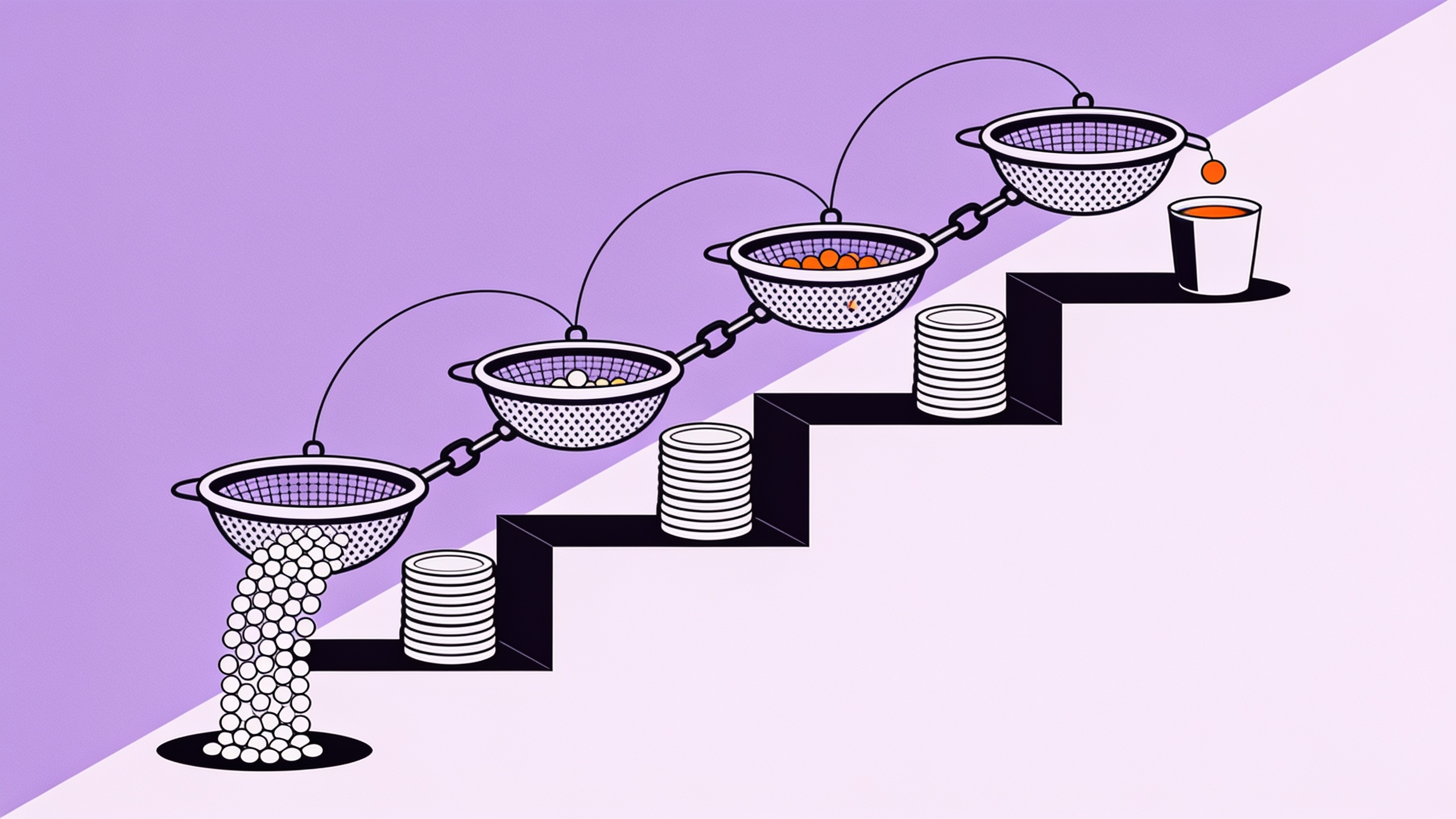
CPM, CPC, CPL and CPA are usually presented as four glossary entries, each with its own definition. In practice they are four links in the same chain. Each cost is the previous one divided by a conversion rate. Understanding that link is what separates reading a report from diagnosing a campaign.
What is the difference between CPM, CPC, CPA and CPL? CPM is cost per thousand impressions; CPC, cost per click; CPL, cost per lead (a captured contact); and CPA, cost per acquisition, usually a sale. All four divide spend by a different outcome. And they chain together: CPC = CPM ÷ (CTR × 1,000), CPL = CPC ÷ landing page conversion rate, CPA = CPL ÷ lead-to-sale rate.
CPM, CPC, CPL and CPA: the four formulas side by side
All four metrics share the same structure: spend divided by something. What changes is the denominator, and the closer it gets to revenue, the more each unit costs.
| Metric | Formula | What it answers | What drives it |
|---|---|---|---|
| CPM (cost per mille) | Spend ÷ impressions × 1,000 | How much does it cost to reach this audience? | Auction, audience, seasonality |
| CPC (cost per click) | Spend ÷ clicks | How much does it cost to bring someone to the site? | Creative and CPM |
| CPL (cost per lead) | Spend ÷ leads | How much does an interested contact cost? | Landing page, offer, form |
| CPA (cost per acquisition) | Spend ÷ final conversions | How much does a customer or a sale cost? | Everything above plus sales |
One detail trips up a lot of teams: "CPA" in Meta Ads Manager is cost per result, and the result is whatever you picked as the objective. If the campaign optimizes for leads, the "CPA" the platform shows is actually a CPL. Before comparing numbers across accounts or agencies, check which event sits in the denominator.
How the four metrics connect (the cost chain)
Take a campaign with these numbers: $30 CPM, 1.5% CTR, 10% of landing page visitors become leads and 4% of leads become sales.
- CPC = 30 ÷ (0.015 × 1,000) = 30 ÷ 15 = $2.00
- CPL = 2.00 ÷ 0.10 = $20.00
- CPA = 20.00 ÷ 0.04 = $500.00
Check it against volume: with a $10,000 budget, $30 per thousand buys about 333,000 impressions. At a 1.5% CTR, that is 5,000 clicks. At 10%, 500 leads. At 4%, 20 sales. And $10,000 ÷ 20 = $500. The math works both ways, which is exactly what makes the chain useful.
The relationship holds in market data too. The WordStream/LocaliQ 2026 benchmark report, covering 13,474 US search campaigns between April 2025 and March 2026, shows a median CPC of $5.42, a conversion rate of 8.18% and a cost per lead of $66.69. Divide 5.42 by 0.0818 and you get $66.26. It is not exact to the cent because each median is calculated separately, but the logic is there.
When to look at each one: CPA went up, now what?
The chain earns its keep in diagnosis. Go back to the example campaign with a $500 CPA. Next month it reaches roughly $650. Here are three scenarios that produce almost the same number:
- CPM rose from $30 to $39. Everything else stayed flat. CPC goes to $2.60, CPL to $26 and CPA to $650. The problem is the auction: more advertisers competing for the same audience, a seasonal peak, an audience that is too narrow.
- CTR dropped from 1.5% to 1.15%. CPM is still $30, but CPC goes to $2.61, CPL to $26.09 and CPA to $652. The problem is the creative: ad fatigue, a message that lost its punch.
- Lead-to-sale conversion dropped from 4% to 3.08%. CPM, CPC and CPL are untouched, and CPA goes to $649. The problem is not media at all. Either lead quality slipped or sales took too long to follow up.
The reading rule is simple: the problem lives in the first link that got worse. Everything after it just inherits the damage. Cutting budget in scenario 3 fixes nothing, because media is delivering exactly what it delivered before. And swapping the creative in scenario 1 might help a little, but it does not address the cause.
CPM: the health of the auction
Look at CPM when you want to know whether it got more expensive to show up. It climbs around Black Friday and the holidays, when the audience is too narrow, or when the platform rates the ad as low relevance. It is the right metric for reach and awareness campaigns, where the goal is to be seen. For anyone selling, a low CPM on its own means nothing: you can buy millions of cheap impressions from people who will never buy.
CPC: the creative thermometer
CPC depends on two things, CPM and CTR. If CPC went up and CPM stayed flat, CTR is the culprit, which means the ad. Cross-check with CTR benchmarks by channel before deciding anything. In search, CPC also reflects keyword competition, and there it is usually the default billing model.
CPL: where the page and the offer show up
If CPC is stable and CPL went up, traffic arrives and does not convert. A slow page, a long form, an unclear offer, or a gap between what the ad promises and what the page delivers. For businesses that sell through conversations (B2B, services, education, real estate), CPL is the most useful media metric, and it is worth going deeper on how to calculate it and what a good cost per lead looks like.
CPA: the business metric
CPA is the only one of the four that speaks directly to margin. A $500 CPA is great if you sell a $6,000 contract and terrible if you sell a $300 product. It only makes sense next to average order value, margin and, for recurring businesses, LTV. Once the sale carries costs beyond media, like a sales team and tools, you are talking about CAC.
Which is better: paying per CPM or per CPC?
It helps to separate two things that often get mixed up: the metric and the billing model. On Meta, most campaigns are billed per impression even when they optimize for conversions. In Google Ads, search bills per click. And a "target CPA" bidding strategy does not mean you pay per sale: you still pay per click, and the algorithm bids so the average cost per conversion lands near your target.
In practice, the billing model matters less than it seems. What matters is optimizing for the event closest to revenue that still has enough volume for the algorithm to learn. If the account generates 200 sales a month, optimize for sales. If it generates 8, optimize for leads or an intermediate event and track CPA separately.
What is a good CPM, CPC, CPL or CPA?
Market benchmarks give you an order of magnitude, never a target. WordStream's $66.69 median CPL blends law firms with restaurants, and even inside one industry the spread between accounts is huge. Auctions are also getting more crowded in markets like Brazil: according to the Digital AdSpend 2026 study by IAB Brasil and Ibope, digital ad spend in the country reached R$ 42.7 billion in 2025, up 12.7%, with 55% going to social media. More money in the auction tends to push CPM up.
The "good" number comes from your own math, not from the market. For CPA, the ceiling is the amount that still leaves profit after margin: if average order value is $800 and contribution margin is 40%, you keep $320 per sale, and any CPA above that loses money on the first purchase. Then walk down the chain: with a 4% lead-to-sale rate, the maximum CPL is $12.80; with a 10% landing page conversion rate, the maximum CPC is $1.28. It is the same logic as break-even ROAS, expressed as cost per unit.
This reverse calculation is the most underrated use of the chain. It turns a business goal into concrete limits for each stage and quickly shows which link has slack and which one is over budget.
Frequently asked questions
What are CPM, CPC and CPA?
CPM is what you pay for a thousand ad impressions. CPC is what you pay, on average, for each click. CPA is what you pay for each final conversion, usually a sale or a signup. All three divide spend by outcomes that sit progressively closer to revenue.
What is the difference between CPA and CPL?
CPL measures the cost of capturing an interested contact; CPA measures the cost of a final conversion. In ecommerce, CPA is usually cost per purchase. In consultative sales, CPA comes after CPL: CPA = CPL ÷ lead-to-sale rate.
How do you calculate CPA?
Divide media spend by the number of conversions in the same period and attribution window. Example: $10,000 spent and 20 sales gives a $500 CPA. Make sure the platform's "CPA" is counting the conversion you think it is.
Is a high CPM bad?
Not necessarily. A more qualified audience often has a higher CPM and converts better. CPM is only a problem when it rises without CTR and conversion making up for it, in other words, when the final CPA gets worse.
Which metric should I optimize campaigns for?
The one closest to revenue that has volume. For online sales, CPA; for demand generation, CPL alongside the lead-to-sale rate. CPM and CPC are for diagnosis, not final targets.
Stop looking at the last number alone
If you only track CPA, you know something got worse but not what. If you track all four links along with the rates between them, you find out in minutes whether the problem is the auction, the creative, the page or the sales team. The obstacle is almost never the formula; it is scattered data: CPM in Meta Ads, CPC in Google Ads, conversions in GA4 and sales in the CRM. Sherlok brings those sources together so you can ask in plain language something like "why did September's CPA go up?" and get the answer already broken down link by link.
Your AI agents already know what to do in your account.
Turn them on free, no credit card.
- No credit card
- Read-only access
- Revoke it any time